
Iranian Journal of Materials Science and Engineering
Iran University of Science & Technology
Wed, Oct 14, 2026
[Archive]


Volume 23, Issue 3 (September 2026)
IJMSE 2026, 23(3): 89-102 |
Back to browse issues page



Download citation:
BibTeX | RIS | EndNote | Medlars | ProCite | Reference Manager | RefWorks
Send citation to:


BibTeX | RIS | EndNote | Medlars | ProCite | Reference Manager | RefWorks
Send citation to:
Heydari H, zolfaghari M. Effect of Twin Boundary Density on Mechanical Response and Dislocation Evolution in a Nickel-Based Superalloy: A Molecular Dynamics Study. IJMSE 2026; 23 (3) :89-102
URL: http://ijmse.iust.ac.ir/article-1-4525-en.html
URL: http://ijmse.iust.ac.ir/article-1-4525-en.html


Abstract: (5835 Views)
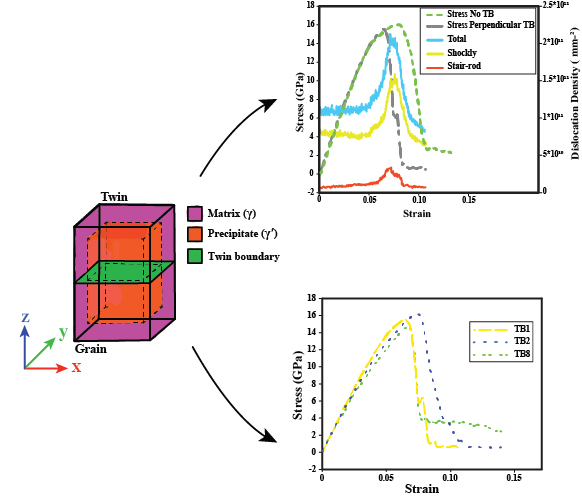
Twin-boundary engineering provides an effective approach for tailoring the mechanical response of nickel-based superalloys; however, the density-dependent atomistic mechanisms remain insufficiently understood in explicit dual-phase γ/γ′ microstructures. Molecular dynamics simulations were performed on a single-crystal model and models containing one, two, and eight twin boundaries oriented perpendicular to the loading direction. The tensile response was analyzed in conjunction with dislocation-density evolution, microstructural changes, and Constructed-surface-mesh analysis to characterize crack initiation and growth. The TB1 model exhibited higher yield stress and strain than the single-crystal model because the isolated twin boundary impeded dislocation motion. In contrast, TB2 and TB8 yielded at lower stresses and strains because the increased twin-boundary density introduced additional preferential nucleation sites at the twin boundaries and twin-boundary/γ–γ′ interface intersections. Despite its earlier yielding, TB2 exhibited the highest ultimate stress among all models and the highest ultimate strain among the twinned models. This behavior was attributed to deformation partitioning between two comparatively stable twin boundaries, which promoted distributed precipitate shearing, dislocation storage, and sustained strain hardening. TB8 exhibited the highest initial dislocation density, followed by a decrease during plastic deformation associated with twin-boundary migration, defect rearrangement, and strain localization. Constructed-surface-mesh analysis further showed that crack initiation was delayed to a strain of approximately 0.07356 in TB2, compared with approximately 0.066 in TB1 and TB8. Crack propagation occurred predominantly along the twin boundaries and γ/γ′ phase interfaces. These findings reveal a non-monotonic, density-dependent transition from barrier-controlled strengthening in TB1 to deformation-partitioning-assisted hardening in TB2 and boundary-migration-assisted, localization-dominated softening in TB8.
Keywords: Nickel-based superalloy, Twin boundary, Dislocation evolution, Dislocation density, Molecular dynamics.
Type of Study: Research Paper |
Subject:
Materials Modeling and Simulation
Send email to the article author
| Rights and permissions | |
 |
This work is licensed under a Creative Commons Attribution-NonCommercial 4.0 International License. |